9/11, PPD, and Learning to Love the Life I’ve Been Given
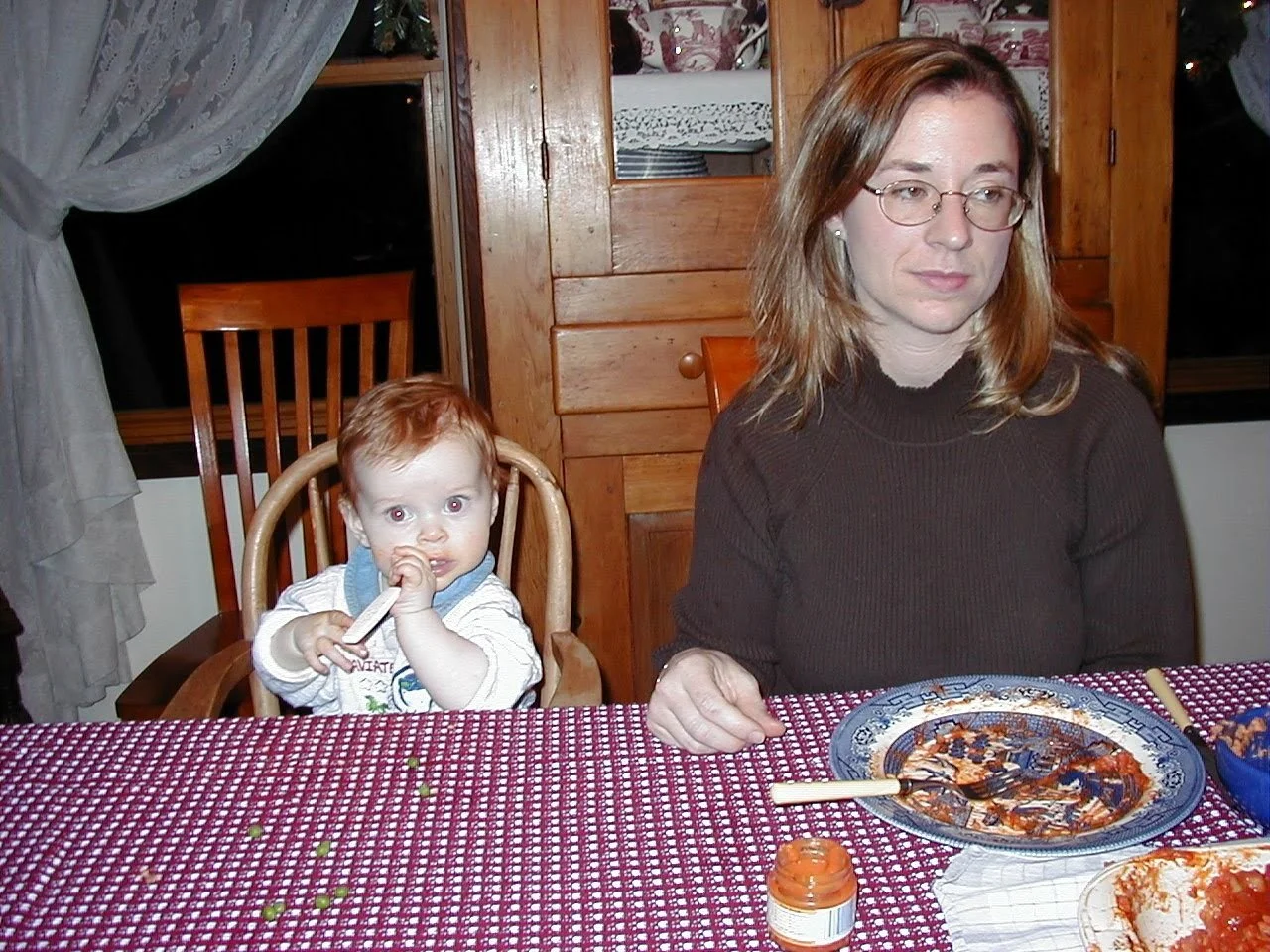
Autumn, 2001. Not happy, but trying.
“Depression at any stage in life is at it’s heart, an identity crisis.”
~ my therapist, early September 2001 (paraphrased)
It’s hard to believe that 9/11 happened twenty-five years ago. While many people can recall where they were or what they were doing that day, many of the details are hazy to me, not because I’m trying to block that specific event out of my consciousness, but because it occurred at a moment in my life where everything was dark. Not black, but gray, soupy, foggy. Back then, I had a toddler and a four-month-old. I’d recently quit my job as a software engineer to stay home and raise the kids. I was sleep deprived, strung out, anxious, lonely, and scared. No, I was terrified.
In a nutshell, I was a mess.
That morning, as I walked down the stairs, baby in my arms, I heard the TV on. I discovered my toddler standing in front of it, holding his blankie and sucking his thumb. He’d turned it on without my permission.
“We don’t watch TV without mommy,” I said as I crossed the room. “You know the rule.”
He nodded, still sucking his thumb, looking penitent. As I forced myself to look stern, I saw the images on the screen play out behind my toddler’s form—an airplane flying into a building, then an explosion followed by the cascade of debris as the building collapsed. I rushed across the room and turned it off, assuming it was some crime movie, or daytime TV drama nonsense.
This is the only image I’ve ever seen of 9/11, even to this day. My own children never knew it happened until they were in junior high.
How is this possible, you might ask.
Simple, we’d agreed as a family just the week prior that the TV would be off, except for the ½ hour a day that I watched PBS with the toddler while the baby slept. No news, no daytime TV (goodbye Oprah and The View), no nighttime TV. Only Caiou, Baby Einstein, and Elmo. Later, my husband and I would watch a movie after the kids were in bed, but on that fateful day, twenty-five years ago, I’d turned off the news and I still haven’t returned.
Why would I do that?
That, my friend, is a story that seems quite appropriate to share at this moment in time, on this 25th anniversary of both 9/11 and the week I’d decided to learn to love the life I’d been given.
An Identity Crisis That Repeats Itself
My PPD actually began when I found out I was pregnant with my first child. Totally unplanned, I was on the pill, and I despised those two pink lines on the pregnancy test. You see, I was told my entire life that motherhood was treachery. Painful. Subordination. The end of my life. I mean, my own mother has told me a million times that she regretted having children. That when I was born all her dreams had died. That she gave up her independence, happiness, and life for me. This is not an exaggeration; I have memories as early as five of her saying these things. The other day, my husband asked her what her greatest achievement in life was and she said passing some test for her career back in the ‘60s. Nothing was important after that. So it was no surprise to me that in 1998, when I informed my parents that I was unexpectedly pregnant, they both felt that all their dreams for me had died as well.
To be fair, this was also the message from the world at large. I will admit it, I wasn’t a beautiful girl, but I was smart, and teachers encouraged me at an early age to identify with my brains. The world of mothering was for other women, the ones who had less intelligence. I was meant to be in the C-Suite. I was meant for money and power. Not childrearing. When my husband asked me to marry him, I said yes, as long as he didn’t expect children. This was 1997. Let’s be honest, nothing has changed. If anything, the message is even louder now—children are a mistake. They are the destroyer of all good things, and men cannot be trusted to help you. So don’t have kids.
That was the plan, until the pill failed, and I found myself pregnant. It never crossed my mind to have an abortion; this was the child of the man I loved. Even though I wasn’t pleased with this situation, it wasn’t the baby’s fault. So in March of 1999, I gave birth, found a nanny, and quickly went back to work, acting as if nothing had changed.
Yet EVERYTHING had changed. I found I longed for my baby when I wasn’t near him. This made me feel weak. The women at work told me it was hormones and to ignore it. He was better off with the nanny, because I was meant to be at work. I needed to care for myself. Yet why did I want him so badly? Obviously it was hormones because I’d make a terrible SAHM, I knew it. I’d go crazy with such juvenile stimulation. Still, I didn’t want him to be an only child, so soon after we got pregnant again, this time on purpose. I figured it was best to get the whole ordeal done quickly. Two and out.
Then, when I was 6 months pregnant, my nanny informed me she too was pregnant, and that she’d be quitting to stay home with her son. The crisis that followed led me to interview several other women, not liking any of them, and deciding that I’d be the one to stay home. The truth was that I didn’t have it in me to leave another infant like that. I wanted to be with the new baby, at least for the first year. In May of 2001, I welcomed my second son and started my SAHM phase of life.
Those first four months were hell. We cut our income in half and suddenly I was on a strict budget. I was exhausted after two pregnancies and two c-sections in two years. My newborn screamed unless he was touching me. I couldn’t shower without him crying. I couldn’t shit without him crying. It was as if he knew I didn’t really want to do this, that I wasn’t committed, and that if he let me go, I’d never come back.
I was also lonely. I was the only woman in the neighborhood who was at home with the kids. Every day at 7 am, the garage doors would open, and all the minivans or Volvo SUVs would leave for the day, abandoning the streets and playgrounds in silence. At 5 pm, they’d all return and stay inside the rest of the night. I felt like I was living in a bad episode of the Twilight Zone. I wrote a blog about this that was in the top 20 on Medium for weeks. You can read it here (I still stand by most of this).
Worst of all, I was scared of hurting them. A resentment festered in my soul. Why did I think had what it took to do this? I was a terrible mother. I was bound to make them miserable. By July, I began to dream of leaving them. I told myself they’d be better off with their father. He’s a better human than I am (he really is). He couldn’t work from home back then, and worse, he was getting his MBA part-time after work. He also had to travel. I spent long days alone, covered in spit and breastmilk, barely able to wash myself, hair in a messy bun and in sweats. I’d wake up to the sound of the baby crying and cry myself because I was still alive. I’d watch the shadows turn to night, alone and wondering how I could get out. I couldn’t ask my husband to stop his MBA or traveling, we needed him to be successful. Work was his burden now. This was a mistake, but it would take my therapist, Diane, to set me straight.
By August, when my baby was three-months old, he was sleeping more and I could get on the computer. I belonged to a cloth diapering, SAHM group on iVillage, but that day I instead searched for software jobs in other states. Colorado. California. There were lots of them. I fantasized about arranging for my mother-in-law to come and care for the boys while I went on a “retreat,” but really I’d interview for a job and then never return. Serve my husband divorce papers that included granting him full custody of the children. By the end of August, my resume was ready, all I had to do was start submitting.
One night, while my husband was either traveling or at business school, and the children were miraculously asleep, I decided to watch The Hours. This was a horrible choice for a woman suffering from PPD, because it is all about depressed women who succumb to their depression in horrific ways. Virginia Woolfe kills herself in the past while a woman reading her book in the ‘60s decides to abandon her children when they’re five and seven. There’s a scene in the movie where this mother is confronted for her choice to abandon her sons forty years later after one of her children has taken his life. She’s asked what sort of a monster would abandon her children like that. I still remember her face as she explained...”I had a horrible choice, either stay and die, or leave and live.”
For me, who was planning to do just that, time stood still. I don’t recall how the movie ended, because I stopped watching it. I heard a voice, very clearly say, “There is a third option...you can learn to love the life you’ve been given.”
I fell to my knees, sobbing. I began to pray the Hail Mary over and over again. I’m not sure when I got up and took myself to bed. The next day began like all the others—the baby crying and me wishing I were dead, but there was something new—hope.
I called my therapist, Diane, and went to see her a few days later. I told her what I was planning to do and begged her to help me instead learn to love the life I’ve been given, and she did just that.
“Depression occurs when our expectations don’t match our reality,” she said. “So we begin there. Let’s reset your expectations.”
Curiosity, Wonder, and Awe
The Lindsay Clancy trial has brought PPD and the rarer condition of PPP (post-partum psychosis) into the national conversation. I’m not going to discuss her specific situation, and yet I will be giving advice that I think young mothers could benefit from. I’m not a therapist, so here’s your standard please seek help, do not self-diagnose, etc. etc. However, I’m not sure how therapists work right now, so I’m going to share what Diane did for me back in 2001. Moreover, this isn’t just applicable to the transition from maiden to mother, I have continued to live this way, and it has helped me as I transitioned to an empty nester, got through the Covid lockdowns, dealt with losing my home and all my possessions to wildfire, and even as I go through menopause and help my aging parents. At every stage of life, I find that my expectations do not match reality, but fortunately for me, my sons and my PPD taught me that my expectations don’t really matter, it’s the work in front of me that matters.
I was fortunate because I met my therapist, Diane, when I was in high school. She was our family counselor, so she intimately knew my upbringing and was able to jump right in to the solution. At the heart of the matter was an identity crisis. I was told my entire life to avoid mothering, that it was horrible, and beneath me. At that point, I agreed, but was that because of the reality, or was my misery as a mother due to the way I was framing it? Diane refused to start with medications, because they would merely mask the issue. I had to change my heart, and this began by cultivating a sense of curiosity, wonder, and awe as it related to my children and my unique role as a mother.
“Step one,” she said. “You need to invest in your creative and spiritual life.”
I joined the local Catholic Church. From there, I joined the Mom’s Group. I also met a mentor named Martha, a seventy-year-old crone/guardian angel who taught me what it meant to be a mother and a daughter of Christ. Diane had me enlist my parents to watch the kids every Wednesday for a few hours while I visited Martha. We would bake bread, weave at her loom, or sit in prayer. It was Martha who told me to read The Artist’s Way, and soon I was writing and taking myself out on dates. My husband stopped traveling for work and his boss was very accepting. Together we prayed and went to Mass.
“Step two,” she said. “You need to guard your thoughts. Turn off the TV. No more news. It will make you anxious. Commercials and sitcoms set unrealistic expectations and will tell you to buy things.” This also meant no more subscriptions to Vanity Fair or Elle, no catalogues, nothing that would make me long for the things I could no longer afford. It’s hard to resent your wardrobe when you have no clue what’s in that season.
Steps three and four were nutrition and sleep, and again I worked things out with my husband to make both of those things possible. But most important, I was to focus on my creativity and my spirituality, and I’ve been doing so ever since.
A Quarter of a Century of Work
Looking back, it’s hard to believe how quickly time has passed. Things have changed, and yet nothing has changed. For all the young mothers out there, of course you’re not alone, but you’re also not a victim. This is the part that may sound judgy, but please, for the sake of your beautiful soul, consider what I have to say. First and foremost, put down the phone. It is not normal to film yourself crying while holding your infant. Your child is not responsible for your misery, your expectations are. It’s not normal to film yourself throwing ice into the tub while screaming about how much life as a woman sucks. (If you’re not aware of these recent TikTok trends, Google them). This phase of life does hurt because it’s raw and vulnerable; I get it, but pull yourself together. You are a woman, a mother, a creator. You hurt, and the sore nipples and all-night feedings and changing of diapers isn’t glamorous, but it’s not beneath you. None of this is beneath us. It just is. Don’t take any of it personally.
Diane had me start with turning off the TV. In today’s world, that means getting off TikTok. It will make you crazy. IG will make you want things you might no longer be able to afford. You’re not a failure if you don’t enjoy caring for a newborn. You’re also not a failure for not loving every minute of motherhood while wearing long, prairie dresses from Christy Dawn and making your own butter or sourdough bread. Stay off Substack and Facebook. Step back from YouTube and your favorite podcast. Get a dumb phone. Turn off the TV. No news is good news. I haven’t watched the news in 25 years, nor read it, and I haven’t missed a thing.
Go to church. I mean it. If you were raised in a faith, return and lean on it. If you weren’t raised with religion, look at your most faithful friends and ask to attend a service with them. Read sacred texts. Learn to pray. You can’t do this without God, because what is being asked of us as mothers is too big for us. That’s part of what makes it scary. It’s also part of the wonder and awe.
Be curious about your feelings and about the children. They’re constantly changing, and so are you. Learn about their needs. Enter into the simplicity of early childhood. I remember one of those first days at home alone with my toddler and two-week-old son. We were in the living room. I was nursing the baby on the couch, and the toddler was standing in front of us, sucking his thumb and holding his blankie, staring at me. Other than read stories before bedtime, I had no idea how to play with him; I’d spent the first two years of his life at work.
“Would you like me to read to you?” I asked.
“Yes.”
There weren’t a lot of children’s books on the shelf downstairs yet, but I had my copy of the entire Chronicles of Narnia. I tugged The Lion, the Witch, and the Wardrobe from the shelf and figured, why not? I patted the couch next to me and as he crawled up beside me, I started reading. Two hours later, my newborn was asleep in my lap, and my toddler was still engaged.
I recall my nanny telling me that in her eighteen years of service to families in this way, what she’d learned was that all a small child wants is their mother. That’s scary, especially if we think we pretty much suck as mothers, but it’s the reality. By Christmas of 2001, I wasn’t happy, but I was satisfied. Shortly after, when my baby turned ten months old, he stopped crying and would leave my embrace, crawling away to knock over his brother’s blocks. Eventually, he’d run away, laughing and chasing his brother across the playground. I used to think it was the newfound mobility that made him stop crying, but perhaps it was because he knew I’d finally decided to stay with him, rather than leave. He’d sensed my struggle and once he knew I’d chosen him, he was safe. He knew he’d won over my heart.
PPD is real, but it’s not an excuse to refuse to do our duty. Life keeps changing, and no matter how pretty the vision board is, things never really turn out the way you want. As my body ages and my skin wrinkles and the gray hairs form around my temples, I have a choice, am I mad at the realities of aging or am I curious?
I choose to be curious, because I prefer to be free, and true freedom is surrender to the unknown. Scary as it may be sometimes, it’s often best to follow the current rather than fight it. Eventually, it will spit you out somewhere and every time it happens, I always wonder where.
It’s exciting, isn't it, to never know where life will take us next?

May 2026, twenty-five years later. Same boy, same mama. I’m glad I stayed.