Till Death Do Us Part
In his 1608 essay titled "On Poverty of Spirit Observed in the Midst of Riches,” St. Frances De Sales, gives the following advice:
“If you should suffer any loss of goods and then find your heart very grieved and downcast, you are too greatly attached to them, for nothing can be a stronger proof of attachment to something than grief at the loss of it.”
As I read this passage, I thought of my new friend in Chicago who read my memoir about what I experienced the first year after I’d lost everything in a wildfire. As I was leaving Chicago to return to the land for four months, she mentioned that she was amazed that I wasn’t completely wrecked by the experience of losing so much. She wondered how anyone had the courage to return to the land and continue to live on it.
I’ve been thinking about this quite a bit lately, especially now that I’ve been alone on this land for three weeks. Many of us returned, but many more didn’t. Are those of us who have returned somehow poorer in spirit than those who haven’t? I often think we must be the richest in wealth, since we found the financial means to return, yet this passage made me wonder if, at least for me, I might have somehow achieved the first of the beatitudes, “Blessed are those who are poor in spirit, for they will inherit the kingdom of heaven.” I’d never considered it before, but while my reaction to losing everything did involve pain and grief, my grief never involved feelings for losing my things, not even my house. It was something deeper and more about the loss of community and the forest, than it was of anything physical.
“Blessed are those who mourn, for they will be comforted” is another beatitude. In the end, I was comforted. Or so I thought. Grief is a funny thing. It returns when you least expect it, often unearthed by events or circumstances that have nothing to do with the original pain or trauma, yet in some way, every time I return to this place, I’m reminded yet again, of the precarious nature of life.
Alone On the Land
We’re visiting California this time from mid-April to early August. Just about four months. Our elders in Chicago and Nebraska need us to return then and we couldn’t leave Chicago until after my husband’s confirmation on Easter, so the parameters were set by events out of our control. About a month after our arrival, a friend called my husband and invited him to go on a rafting trip in the Grand Canyon. About two hundred miles and twenty-days on the river. The kicker was, he’d have to be ready to go in two days.
I don’t love the water, it scares me. I like to be near water, but not in it. I know this has been on his bucket list forever, so I told him to go for it. I’ve been without him for three weeks in the past. It really isn’t that big of a thing. So off he went.
Here’s the truth—his absence has been a bigger thing than I’d anticipated. Not at first, I enjoy having the house to myself, even more so now that he’s retired. But I can’t get a hold of him. I have no idea where he is. Normally, we text every day when apart. Now, I’m not even sure when he’ll return. I won’t hear from him until he’s almost done with the adventure. I think he’s coming home this weekend, but I’m not sure. After a week of this, some sort of funk arrived in my soul. At first, I couldn’t put a word to it. I just didn’t feel right.
Then it hit me, the night I fled the fire with my youngest son, the night I left so much behind and failed to evacuate like a normal person, I was alone. My husband had gone to Portland with my son, and the power was out, and I couldn’t contact him. Now, I’m alone on this mountain again, without him, unable to contact him. If I’m honest, I’m only here for him, so why am I here alone? Why does it bother me? It’s old feelings of pain and shame, coming back around, reminding me that not all of my body and soul have forgotten that evening, and his absence reminds me of that night.
By the second week of his absence, I started wearing the necklace I bought him for his Confirmation. This week, I’ve started wearing his t-shirts and sleeping on his side of the bed. I’m not poor in spirit, not one bit, because I simply can’t imagine my life without him. Worse, because I can’t talk to him, because I have no idea where he is, and because the grief of the fire still lives within me, I can’t help but feel abandoned. Even worse than this, my imagination has begun to wonder, what would it be like to lose him for real?
A Grief Observed
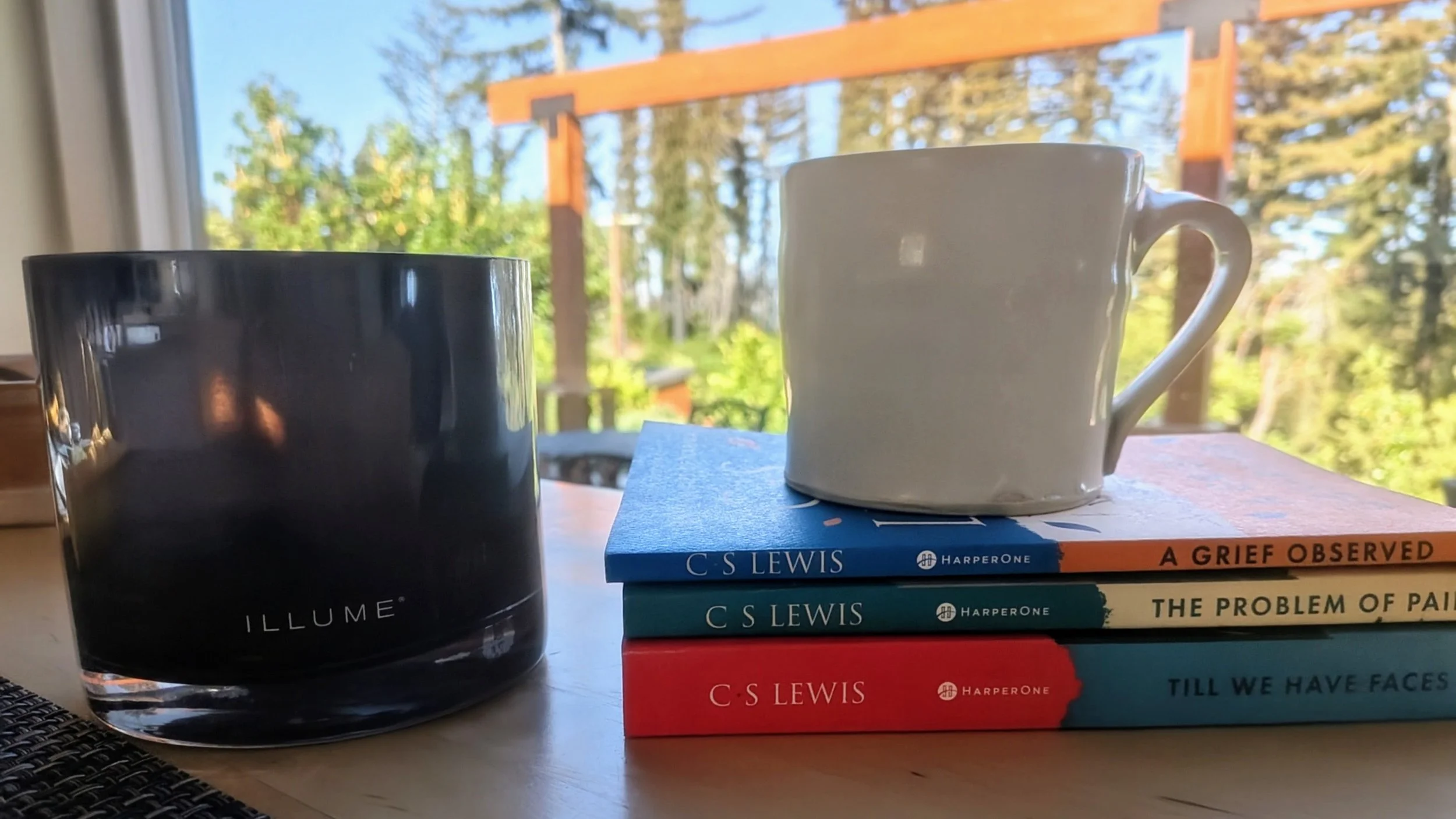
It doesn’t help that I decided to read what is often called C.S. Lewis’s Pain Trilogy, while my husband is away. The Pain Trilogy consists of three works by Lewis: A Grief Observed (memoir about losing his wife), The Problem of Pain (thoughts on why pain is necessary for human growth) and Until We Have Faces (a novel about Cupid and Psyche and the pain of love). I probably should have read these before writing my latest novels, because the three books might have inspired the plotline, however I’m like that. I wait until AFTER a project to read books by others on the same topic. Mostly to see how closely my insights align with theirs.
I completed The Problem With Pain fairly easily, but last night, when I began A Grief Observed, I started crying, not only because it was so painful to consider losing my own spouse, but because of his absence there’s a part of me that can relate. I realize this is NOT the same thing as really losing him, and I mourn so much for my friends who have lost their beloveds like this. As Lewis writes, you are never the same after such a loss. It’s one thing to lose all your stuff, but to lose your husband, wife, or child—I do not wish to know this. I’d rather not be so poor in spirit. Besides, can one ever be over loss? Even the grief of losing my home continues to wash over me when I least expect it. As Lewis writes:
“For in grief, nothing stays put. One keeps emerging from a phase, but it always recurs. Round and Round. Everything repeats. Am I going in circles, or dare I hope I am on a spiral? But if a spiral, am I going up or down it?”
As I wrote in my memoir, I don’t believe there is a hierarchy to pain, and what I lost in the fire is significant. It’s simply that I’d thought it was behind me, but now after three weeks alone on the mountain with no word from the man who is the entire reason I’m even on this mountain, I realize that this is one of those moments where the grief has recurred. Repeated itself, but presented in different, less serious circumstances.
Dare I hope I’m on an upward moving spiral?
Love Ends in Death
To combat melancholy, I’ve done various activities: collage, visiting friends, hosting guests two weekends in a row, promoting my latest novel that released three days after Walt left (for those who have read Grace, you know how ironic that is, given the plotline). I even wrote four chapters for a new novel and have been tending to my dog who had surgery.
Keep yourself busy, that’s the ticket.
Here’s what I learned about me—if I’m sad, I don’t feel like doing any of this. Yet I must, or I will turn into a wreck of a woman. I’m not meant to be alone. I’m better as a mate. I want to wake up with my husband beside me. I want to eat dinner with him and ask how his day was. I want to have him on my arm when I go to a concert.
I don’t like being alone.
I told someone this truth the other night, and he told me I needed to work on this. That I need to be okay being alone. Here’s the thing, I’m okay with being alone. I could become a cloistered nun if my husband left me (and trust me, I probably would), but that’s not the best me. I’m better as a wife than I am as a hermit, even if I idolize hermits.
Over coffee this morning, I read this passage from A Grief Observed and it clicked—this is why I miss my husband, why I don’t like such long separations. It’s not simply that being on the land alone triggers the traumatic residues left behind from the night of the evacuation. It’s more than that. It’s because I love being married to him, yes, but it’s also because this sort of separation is a reminder of both the true meaning, but also the true ending of marriage. Lewis writes,
“There is, hidden or flaunted, a sword between the sexes until an entire marriage reconciles them. Jointly, the two become fully human. Thus, by a paradox, this carnival of sexuality leads us out beyond our sexes.
And then, one or the other dies. And we think of this as love cut short; like a dance stopped in mid-career. Something truncated and therefore lacking its due shape. I wonder. If, as I can’t help suspecting, the dead also feel the pains of separation, then for both lovers, and for all pairs of lovers without exception, bereavement is a universal and integral part of our experience of love. It follows marriage as normally as marriage follows courtship or as autumn follows summer. It is not a truncation of the process, but one of its phases.”
There it is then; love ends in death. Under the best of circumstances, marriage means someone is left standing by the grave, yet Lewis hints that perhaps the dead are also bereft. It’s truly strange how events aligned themselves so that I’d be alone on this land the week my novel Grace: A love story, part two is released, pondering the loss of my home and belongings, the terror of being alone on that dark, smoky night, and the way that grief has been unearthed yet again, only to remind me that while I might be able to congratulate myself for surviving that wildfire loss and for even letting go of what I once had, I still have far to go before I can truly say I’m poor in spirit.
For I’m not at peace with the reality that one day, I really will be separated from my beloved. I don’t see how one is comforted in such a loss. It feels impossible. Yet, I know from my widow friends it is possible. I see them recovering and becoming whole, without having to forget the one they lost. Lewis ends his short memoir with this revelation,
“The more joy there can be in the marriage between the living and the dead, the better. For, as I have discovered, passionate grief does not link us with the dead but cuts us off from them.”
This then is the gift—that the abundance and joy of love can outlast all grief. The great comfort is that realization that the gift is not only in the kisses and the joy of waking up beside the person you love most in the world, but it’s also in missing them, whether temporary as they live out their bucket list adventures, or permanently, when one or the other of us has found our time is up.
I guess love really is all we need.*
*but I still want my man to get home soon 😉